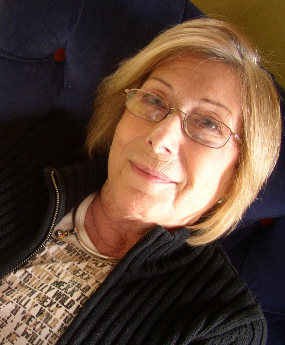
Rita Marion Knopf
Thank you all very much for joining today to celebrate Mum’s life and to mourn our loss of her. It is touching to see so many people here.
Amongst those here today are Laurence, my brother, his wife Emma and their lovely sons, Oscar, Jaxon and Casper. Also my partner Harriet, and our equally lovely children, Cyrus and Lorelei. Mum was so very proud of all five of her grandchildren.
I was fifteen years old when I was made to use my powers of persuasion to convince Mum that something I wanted to do was actually quite normal really. I just wanted to be allowed to go camping with friends for a few days. After much bargaining, among the things I had to promise, was that when we got to the campsite I would call her. Of course, I didn’t. The first thing we did was head into the leisure centre to have a go on their roller-skating rink. As I was inelegantly windmilling round the rink, failing to look cool … “bing bong!” … there came an announcement over the tannoy.
“Will Steven Noff please call his mother.”
Mortified, I skated round the rink a whole circuit, and then another, and then one more until I thought I could exit without being identified as that teenager-who-had-to-call-his-mummy. When I hadn’t called her she had somehow worked out that I would be in the leisure centre. She looked up the telephone number in the yellow pages, called, and persuaded them to place that announcement over the tannoy. At the public phone box, when I heard the pips and dropped my five pence in the slot I duly got an earful. It didn’t last long though. She was more relieved than angry.
But, it’s not the anxiety I triggered in Mum that day that I want you to take away from this story, it’s her determination. Since she died on Friday a lot of you have contacted me to let me know what you thought of her. “Strong”, “brave”, “courageous”, “admirable”, “firm” and “remarkable” are some of the words you have used.
Oscar, Jaxon and Casper would say that their Omama got that strength from being with family. She loved the meals that she would share with them.
Mum had already lived in five different places. One of them was Terezin, a Nazi concentration camp
Born in Vienna, by the time she was fifteen, that same age where I wasn’t even allowed to go camping unreconnoitered, Mum had already lived in five different places. One of them was Terezin, a Nazi concentration camp thirty miles north of Prague.
She was born Rita Hahn in 1931. In those early years she lived with her father Robert, a dentist, her mother Irene, a legal secretary and her maternal grandparents. The first time the family moved was in 1939, when Rita was eight years old. They were forced to move because their apartment was considered “too big for Jews”.
Around this time, her father left for Holland en route to England. The plan, that the rest of the family would follow on, was foiled by the start of the war and the tightening of travel restrictions.
In 1940, Rita’s grandmother died. Mum and Irene were forced to move again, this time to a single room in the Im Werd district of Vienna, a place where the authorities were concentrating Jews. Irene spent her evenings combing the streets for vegetables that had been discarded from the daily food market, the Karmelitermarkt, which took place in the square beneath their third floor window.
she didn’t have a can-do attitude, she had a must-do attitude
Some of the other adjectives that people have used about Rita in the past few days recall how full of life she was. In 2019, when we visited Vienna with Mum, on the last day of our trip she made our airport cab driver do a detour, to take us to that very square, the Karmelitermarkt. She didn’t want to get out of the cab or anything like that. She just said she wanted to show the place that she was still alive. She was determined to do that. Like Cyrus has said about his Omama, she didn’t have a can-do attitude, she had a must-do attitude.
In 1942 Rita and Irene were deported. They were put on the very last transport out of Vienna to Terezin. Mum was eleven years old, and destined to spend the next three years there, living in a separate building from her mother, working in a factory and on the farmland. She had a pre-existing lung condition, contracted encephalitis, recovered and then yellow jaundice and recovered.
She lived on half a loaf of bread a week (which was usually blue with mould when it was handed to her), and she went from building to building each day begging for leftovers of the potato skin soup that was to be her staple diet.
Terezin wasn’t at this point an extermination camp, but it was slated to become one. But those plans were thwarted in 1945 by the end of the war and the “liberation” of the camp by Russian soldiers.
Mum was in the chorus of a camp inhabitants production of “Im weißen Rößl” (“The White Horse Inn”)
Mum and Irene’s route from Terezin included six months in Deggendorf Displaced Persons camp. At Deggendorf there was food. There were lessons. There were supervised sports. There were trips to see the bombed-out city of Munich. Mum knew there was a lot of growing up to do. She took walks with other displaced kids where they would discuss their future lives. Perhaps the highlight was when Irene took the lead and Mum was in the chorus of a camp inhabitants production of “Im weißen Rößl” (“The White Horse Inn”) a musical comedy which was a very popular operetta in the early twentieth century. She also talks about experiencing her first Seder night in Deggendorf with a Polish family. She called this a turning point in her Jewish and her Zionistic life. Mum called it an exciting period of personal change. It was the pivot around which the rest of her life was levered.
By September 1946, Rita and her mother were aboard a ferry bound for England. At Dover they were met by Robert, but he never lived with his wife and daughter again and Irene and he got divorced. Mum went to Parliament Hill School and then Barrett’s Street Technical College where she studied dressmaking and design which she went on to do as a job in various firms including eventually her father’s couture company, Robita.
Kurt and Rita were the best looking couple ever, and so much in love
In 1950 she met Dad at an AJEX (the Jewish MilitaryAssociation) dance. Two years later they married. Vivienne Hahn Howard, Rita’s cousin (now living in Canada), has fond memories of being a bridesmaid at Mum and Dad’s wedding in Belsize Park Synagogue. “Kurt and Rita were the best looking couple ever, and so much in love” she told me on Saturday on the phone. In 1956 Kurt and Rita emigrated to America, only to come back in 1958 having decided England was where they wanted to make a life. And it is here that they made two boys, made a family; she made countless Friday night roast chickens and Saturday lunchtime dishes of spaghetti bolognese.
Over the past few days it was interesting how many of you, when I asked you about my mother, unprompted would also talk about my Dad and about how great they were together. Ruth and Roger Cole, here today, emailed me: “A dinner outing with Kurt and Rita was often rowdy, full of laughter, and eagerness to live life to the full. It was amazing how they arrived as refugees, made lives for themselves, brought up their families and were never bitter about their awful experiences and the cards that life had dealt them!” I think most importantly Mum and Dad just made a good team. Growing up it felt like her super-power was to protect and his super-power was to permit. I can’t remember a time when a question I asked him did not get the response “Yes, sure, why not.” Occasionally he did have one other answer, when he was a little worried he would say “Go ask your mother.”
Dad died in January 2015. And later we will be standing next to his grave as we bury Mum. In the past ten years she has missed him fiercely and so have the rest of us. I got to know Mum in a way that was different to when they were “Mum and Dad”. But still there are always those last opportunities to do X that you miss at the time and then regret later.
In recent years Mum’s life has been hugely supported by the great carers she has had, many of whom are here today; Ali, Cristina, Jessica, Loredana, Lorenda, Nushika and Wahiza. Thank you to all of you for the amazing jobs you did right up to the end.
Laurence wants you to know that he never felt any pressure from our parents to be anything other than what he wanted to be. He says his non-standard route through life was never challenged and only ever supported by Mum and Dad. Personally, I think he has had a fairly standard route through life for a personal-training-digital-marketing-SEO-optimising-theatre-studying-UK-hip-hop-elder-stateman-crypto-entrepreneur-dad. But I get what he means.
Lorelei thinks that the thing that drove Omama on day-after-day was her appetite for new experiences. On 24 December, I sat next to her bed for four hours on and off. For a lot of that time she was drifting in and out of sleep. After that point she would barely make it out of bed again. But when I told her that my family were coming to visit her and that we would be combining it with a trip to JW3 to watch the Jewish Pantomime, “Golda Frocks and the Bear Mitzvah”, she asked me to add her to the trip and immediately buy her a ticket.
how a woman who had already long stopped eating and drinking could still find the energy to be so wryly charming.
The last time I saw Mum out of bed it wasn’t actually in person. It was on a video that Nushika sent me of Mum, on Boxing Day, sitting on the edge of her bed and singing songs. She sang (Rabbi, please forgive me) “O Tannenbaum” and “Stille Nacht, Heilige Nacht” amongst others. She finished off her impromptu, unannounced, farewell concert with “Es muß Wunderbares sein” (“It must be something wonderful”) from that Deggendorf operetta “The White Horse Inn”. I like to think, in her head, she was back there in Deggendorf when she sang that song. It was a moment of transition for her. Maybe the morphine had liberated her from pain like the Russians had liberated her eighty years prior. Maybe the Midazolam had lifted her spirits just like the lessons and the gymnastics and the sports had done so in that camp. Maybe she saw her carers as the wonderful adults that looked after her in Deggendorf. I don’t know.
I’ll close with Mum’s words from that final video. This is what she said to camera: “Please forgive me if I have said many things that weren’t quite so right, but it has been a terrible few days, and I love you all, some a bit more, some a bit less.” Off camera, Nushika is giggling hard and like me she is probably wondering how a woman who had already long stopped eating and drinking could still find the energy to be so wryly charming.