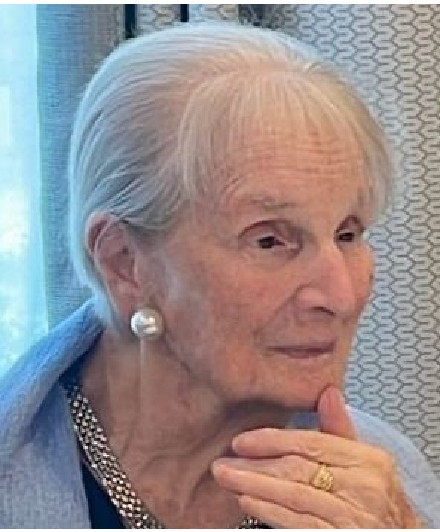
Jacqueline Charles
Good afternoon, and thank you all so much for being here at such short notice.
My dear father, given his enduring interest specifically in the only important London team, and in football in general would, I think, have described the relationship I enjoyed with my darling mother as “a game of two halves”. And he would have been right. You know, the pre- and the post-dementia halves. The thing I want to impress on you though, and perhaps this is something that might surprise you, is that both of those halves, although of different lengths and characters, were equally important, joyous, and enriching for me. And equally, I know for sure, for her.
an incredible role model
Michael has beautifully encapsulated Mum’s early years, before my brothers and I had taken the field. For me, her subsequent “first half” performance was triumphant. She was an incredible role model. As a mother, in the Whetstone years, she was firm and perhaps betraying her Northern roots pretty no nonsense. And yet she managed at the same time always to be non-judgemental, kind and caring.
Mum was quite a shy person, a foil to Dad’s gregariousness. But she loved it when each of us would have our friends round. And somehow she was renowned as being very hospitable, even though she was famously a most terrible cook. The apple, I suppose, doesn’t fall far from the tree! No challah baker, or cordon-bleu chef, she went about mastering the few simple dishes required to ensure the family made it from one week to the next, without starving to death.She then stuck rigidly to the knitting: we all knew, if it was spaghetti bolognaise for dinner, that it must be Thursday.
She was perceptive. There was once a famous party at our new home, in Camden (or Regents Park, depending on who I was talking to) to which we had moved when Dad wanted to be nearer his beloved office. Things got a bit out of hand. Obviously, “les parents” were away, and the damage included some broken furniture, the proper repair of which was well beyond our means. We arranged for a cheap but affordable job instead, effectively just sticking the broken bits together, and hoping for the best. The short-term nature of this solution meant the damage was quickly revealed, its origins becoming the subject of much parental debate. Many years later, she let me in on her secret.She knew perfectly well how it had happened, but had chosen to quietly keep her counsel.
She always wanted me to be the best version of myself. This included her keenness to foster my independence, allowing me from a ludicrously young age, indeed, requiring me, to travel alone on all parts of the London transport system. This did my early social life no harm. And she was endlessly supportive of all my endeavours; helping with homework and schlepping far and wide to watch my gymnastics displays.
Utterly devoted to Dad, she similarly pursued all his interests, from classical concerts, to his love of shul, even becoming chair of the Central Synagogue Ladies Guild. And holidaying with him as he trawled across America in the bizarre pursuit of seeing all the State capitals. Something I think they accomplished just before he fell ill.
a barrister, a law reporter, a senior magistrate and a tribunal chair
At a time when very few women even attended university, let alone balanced a professional career with a family, all this family fun was being played out in the context of her own extraordinary legal career. As a barrister, a law reporter, a senior magistrate and a tribunal chair. I can still recall the pride I felt then, going to various Courts to watch her in my school holidays. Or, later, having no doubt been inspired to study law myself through her example, when I would struggle through a long case, and see, at the bottom, that it was she, Jacqueline Charles, Barrister at Law who had faithfully reported it.
My early years could not have been bathed in more supportive love, more wise guidance, and more mutual respect. I think, I know actually, that the flip-side of this closeness was that she found it a little bit hard when I met Richard to let me go. The day after our wedding she volunteered, quite unnecessarily, to drive us all the way to Gatwick airport. Richard always remembers the slightly teary look on her face as she left us on our honeymoon to drive rather forlornly back to London. She needn’t have worried. She remained a constant presence, and we spoke pretty well every day. At a time when calls to a landline were the norm, Richard (who she absolutely adored) regularly labelled me a witch, when I correctly predicted that the ringing phone was going to be a call from Mum.
But the hectic and rich first half, that we all somehow thought would go on for ever, came slowly to an end. By half-time, Mum had three kids, and each of them had three kids, surely that says all that needs to be said about the security she created for each of us in the family. And then, as the second half almost imperceptibly got underway, the landscape changed. Dad became unwell, and Mum was naturally a wonderful carer for him. At the same time, she herself moved gradually, but increasingly, into dementia’s cruel path. Once a bollard had mysteriously jumped out at her, in the middle of Regents Park, bursting one of her tyres, we reluctantly had to take away her driving licence. Something she was less than thrilled about. But she soldiered on, taking the bus and clinging to her independence for as long as possible, just as we could have predicted she would.
After her beloved Eric died, she continued to live at home, alone now with some help during the day. Richard and I would often give her dinner at 261, and then take her back to settle her into bed. As worried about her as I sometimes was, on the drive home, I enjoyed these quiet few moments with her at the end of a busy day more than I can say. Finally, some three and a half years ago, the welcoming doors of Hammerson House opened to her, and a new and final chapter had begun. Injury time, if you like…
Our roles had reversed: she had cared so beautifully for me for so many years, and now it was my time to repay the compliment and to care for her.
always looked her glamorous best, fully-adorned with rings, a necklace and earrings
With the unbelievable help and support of the entire Hammerson House family, who I cannot thank enough and who I love so much, Mum’s last years were lived in comfort and community. I visited her often, some might say too often, but it was never once a burden or an obligation. It was a joy and a privilege. Even in the appalling devastation of her dementia, she knew most days that I was there. She puckered her lips to kiss me when I offered her my cheek, and I told her I loved her every single visit. Sometimes, I believe, she even told me back. Mum was a dignified presence, known throughout the Home, and always smartly-dressed. Her extraordinary carer, Arvin, who had also looked after Dad, was responsible for that, ensuring she was perfectly supported and always looked her glamorous best, fully-adorned with rings, a necklace and earrings. Thank you so much, Arvin, we could not have done it without you.
I now feel so very sad. The referee has blown the whistle for full time, bringing the second half to a close. But my goodness, what a match it was for her. And, for me.
Mum has left behind not just her three kids and nine adored grandchildren, but four beautiful great-grandchildren, to carry forward her legacy into the next generation.
I have no regrets, only my never-ending love and gratitude for all she did for me, and for the true privilege, in the end, of what she allowed me to do for her. And how many of us are lucky enough to say that?
Thank you, Mum. Rest in peace. I love you, and I always will.