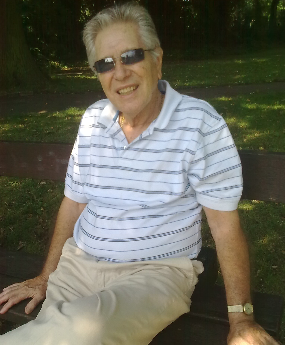
Kurt Knopf
How does someone who was born in 1920s Vienna and whose early memories of fun include running into unsuspecting Austrian farmers’ fields and eating the corn directly off the stems, manage to then steer a course, through being a refugee, through fighting a war, through dealing with austerity and uncertainty, through the ups and downs of love, the successes and failures in business, raising two bolshy sons and through sixty three years of married life, to end up in twenty-first century London, and remain sane?
I don’t know.
remaining sane, remaining proud, remaining likeable, loyal, and above all with a sense of humour and a smile
Just the difference between 1920s Vienna and twenty-first century London makes my head spin. If I started in the former and ended in the latter I don’t think I would be able to reconcile the two. Forget being a refugee, forget fighting a bloody war, forget the hardships of starting life all over again without parents or siblings around you, forget being harassed by two sons who had it so good they had no idea how lucky they were, forget keeping a relationship going for sixty-five years. Even without any of that, the contrast between where my Dad started life, and where he ended life is huge.
But not only did he make it through all that, but he did so whilst remaining sane, remaining proud, remaining likeable, loyal, and above all with a sense of humour and a smile.
He was a proud, strong and stubborn man from very early in his life. In 1939, his father, Sigismund Knopf, recognised that with the Nazis about to enter Vienna, of his two living sons, Kurt Knopf would be the one with his back against the wall, if he was allowed even one close-up encounter with the German soldiers. So allowing his other son Erwin to stay in Vienna, he packed Kurt off on the Kindertransport to England.
I don’t know what his life would have been like if it were not for the Nazis. What he would have excelled at, at school; what life would have been like if he grew up with his brother, aunts, uncles and cousins around him; how he would have rebelled as a teenager; what a life of exploration and romance he would have had in Vienna in his twenties; what career he would have chosen.
the Nazis gave him an even stronger sense of injustice, and with it a strength and stubbornness that would resurface later in life
More importantly though, is the fact that nor did he. How could he know what his life would have been like? How could he know what was taken away from him? The Nazis did give him one thing though. For a boy who already had a strong sense of justice, the Nazis gave him an even stronger sense of injustice, and with it a strength and stubbornness that would resurface later in life. In his eighties he was blighted by Austrian and German officials who would regularly send him thirty page forms to fill in to prove he was still alive and still worthy of their reparations. He would send these back incomplete with barely legible hand-scrawled cover notes saying that he had no intention of wasting his time with their bureaucracies. As far as I know the money never dried up.
In England he was sent to a boarding school in Buxton. A couple of years ago, he and I took a stroll around the perimeter of that school, courtesy of that little yellow man with dangly legs in Google Maps. We talked about he, Laurence and I making a real trip there one day.
After boarding school he moved to Birmingham. He worked in the Grand Hotel looking after the guests using the billiards room. Making the most of the opportunity he saved up quite a bit of money and deposited it in the local Midland Bank. Last year he had me write to the bank to ask if they still had his account. They didn’t. He let it go, but not before he made me take that yellow Google man for a walk around the streets near the Grand Hotel to see if the bank branch was still there.
butler/valet to the Home Secretary Gwilym Lloyd-George
He must have honed his serving skills at The Grand. Because, later, in the mid to late fifties he got the job of butler/valet to the Home Secretary Gwilym Lloyd-George. Serving him at his apartments in St. James’s Place.
But back in 1942 Dad lied to the army about his age and enlisted. Then, on 12 June 12 1944, he landed on the beach at Arromanches. It was D-Day plus six, he was eighteen years old. He saw action but told my brother and I very few stories about the war itself. After the war he was assigned to British Intelligence because he could act as a translator. He worked in POW camps debriefing senior German Generals and in the Ruhr helping to run German coal mines which were under Allied control.
In 1950, Dad’s army buddy, Hans Grant, introduced Dad to Rita Hahn,Mum. They met at the Association of Jewish Refugees. Dad did not get off work until 10pm, so Mum agreed to meet him then. Apparently several people tried to dissuade my Mum from meeting a stranger this late at night. Laurence and I are very grateful she did not listen to them. In 1952 they started their sixty three year marriage.
the wind in Manhattan was so cold that when he stood on a street corner he could literally feel his brain shrinking inside his skull.
In 1957 Gwilym Lloyd George retired as Home Secretary. and, in what I presume was an unrelated move, my parents went to live in New York. Life there was different. Opportunities materialised and then vanished. At one point both Mum and Dad worked at Macey’s the department store; she on perfume and he on socks. They spent two years in New York. It was the winters that finally sealed their decision to leave. My Dad said that the wind in Manhattan was so cold that when he stood on a street corner he could literally feel his brain shrinking inside his skull.
How much of what my Dad told me throughout my life I should have believed and how much I should have grinned at, I will never quite know. I mean I know now that there isn’t a tribe of monks in the Himalayas who live solely on dried apricots, and I know now that the strange sound that we occasionally heard in our back garden in Edgware when I was very young was not caused by “caravans falling through the sky”. But how much else of what he told my brother and I was fantasy we do not know. We could be walking round believing all sorts of stuff that other people know is rubbish.
Dad and Mum came back to England in 1959. In 1968 they settled in Edgware when they decided to start a family.
Dad was a great Dad, and Mum a great Mum. He did everything he could to give us all the opportunities we could use.
Arsenal, Glenn Miller, Bridge, gambling in general (which he did quite successfully) and dried apricots
As a son, how much you know your father as a man rather than just as a father I don’t know. If you asked me, apart from the family, his passions were Arsenal, Glenn Miller, Bridge, gambling in general (which he did quite successfully) and dried apricots. But there are people here today who knew the man as a man and not as a father. You will have known him differently to how my brother and I did. You may have known him as a friend or a colleague. Of course he was also a son, a brother, and to Mum a husband.
I didn’t know him in all these other ways. But I did love him. I loved him for his pride, his easy-going nature one minute and his stubbornness the next, for his loyalty, for his sense of fun, for his sense of justice and injustice.
These past few months have taught me how quickly someone can be taken away from you. And before the person finally goes you hardly notice other things going as well. It was only in retrospect that I realised I had missed the last opportunity to have meaningful conversation with him. After that point Laurence and I talked to him a lot, telling him how much we loved and respected him and how grateful we were for the great life he gave us. But it was too late for meaningful responses. We stroked his head and his hands and we tried to make him comfortable. It came so naturally near the end.
Did he realise how many people loved and respected him?
David Dornfeld recently told me: He was a great man and one who taught us all about the respect and kindness to be shown to others.
Vivienne Howard recently told me: I thought your Dad looked like a movie star, so handsome. Later I found out what a dear person he was.
Renate Cave recently told me: He was a good friend of Richard’s. Richard even gave your Dad his own job. They often laughed about that.
Lee Dornfeld recently told me: Your Dad was kind, funny, caring and loved by so many over so many miles.
Lorelei Knopf recently told me: Up until he was ill he would always play with me and he was always happy to see us.
and Cyrus Knopf told me yesterday that he will remember Opapa for teaching him poker.
If I had my chances all over again I would have so many things to ask him. What were his hopes and ambitions and dreams before 1939 happened? Did he find enough happiness in the life that was foisted upon him? Did he realise how many people loved and respected him?
If Einstein’s general theory of relativity is true, and we live in a space-time continuum, then all times are equally real. In such a, so-called, block universe what we think of as the past, present and future all continue to exist. If the universe is like this then Dad is still here in the universe. Somewhere he is in a small field outside Vienna, with a friend, picking corn cobs directly from their stems and eating the sweet kernels raw and lying back on the ground staring at the sun.